
Three tabs open on my laptop. Same word in the search bar, “pregnenolone.” Three completely different products staring back at me: a $12 bottle from a supplement aisle, a “research use only” powder from a chemical supplier, and a compounded prescription that requires an actual conversation with an actual clinician first. Same molecule, allegedly. Wildly different levels of trust behind each one.
I went into this expecting to find a clear winner and a bunch of noise. I found that, but I also found something the sellers don’t advertise: even the best-run version of this product is standing on thin scientific ground. So before I hand out grades, I want to be straight with you about that, because no amount of good sourcing turns a lightly-tested compound into a proven one.
What each route claims to be
The supplement bottle claims to be a wellness product, sold cheap, sold fast, no questions asked. The research powder doesn’t really claim anything, it just sits there labeled “not for human consumption,” which should tell you everything before you read the ingredients. The compounded prescription route claims to be the responsible version: a physician decides if it fits you, a licensed 503A pharmacy makes it to USP standards, and someone follows up later to see how you’re doing.
That third claim is the one worth testing. So that’s what I did, treating each option the way I’d treat any product I’m reviewing: what does it say about itself, and does that hold up once you look closely.
My honest read on the science, before anything else
Here’s the thing nobody selling this stuff wants front and center: pregnenolone’s human evidence is genuinely thin. It’s the steroid your body makes first, at the top of a pathway that eventually produces DHEA, progesterone, cortisol, testosterone, and estrogen. That’s real biochemistry. It’s also exactly the kind of fact that gets stretched into “upstream of everything, so it fixes everything,” which the actual studies don’t back up.
What does exist is small, mostly in psychiatric patients rather than healthy people chasing more energy, and the dosing is a mess:
- A Duke trial gave 21 people with schizophrenia or schizoaffective disorder up to 500 mg per day for eight weeks. Negative symptoms improved (mean change 10.38 vs 2.33 on placebo, p=0.048), but the main cognitive measures didn’t budge [P1].
- A two-center trial in 60 people with recent-onset schizophrenia used a much smaller dose, 50 mg per day, and found a real reduction in visual-attention deficits (p=0.002) [P2].
- A three-arm trial in 58 patients found 30 mg per day helped positive symptoms and attention, while 200 mg per day did nothing better than placebo [P3].
- An 80-person bipolar depression trial titrated up to 500 mg per day over 12 weeks and saw a real improvement on the Hamilton depression scale (p=0.025), tolerated reasonably well [P4].
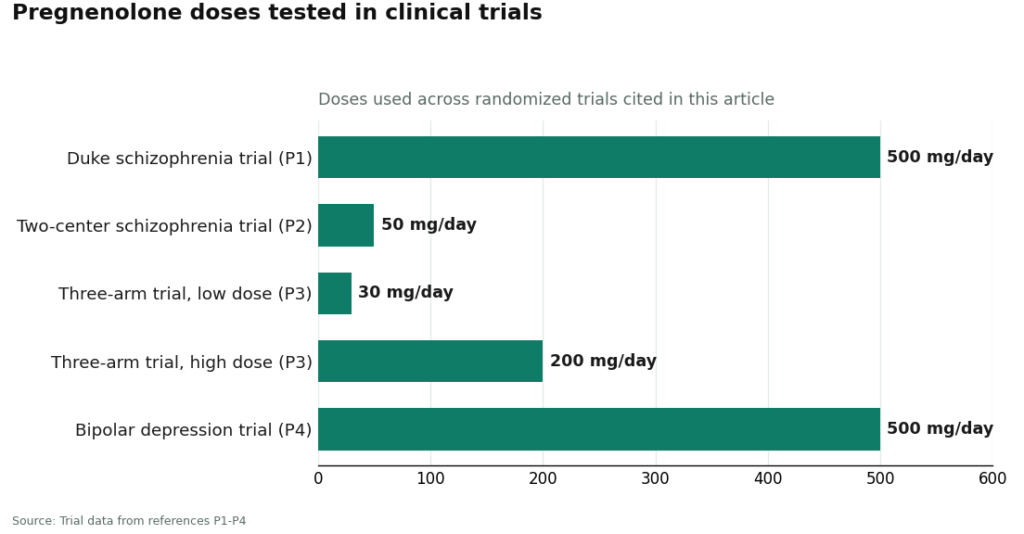
Read that list twice and you’ll notice the problem isn’t a lack of data exactly, it’s that the data disagrees with itself. Thirty milligrams worked in one trial and two hundred didn’t. Fifty worked in another. Five hundred worked in two more, for different conditions entirely. Nobody has run the large, long trial in healthy adults that would actually justify the “boosts energy and fights aging” pitch you see on supplement pages. So my honest take: good sourcing buys you a real product and a person paying attention. It does not buy you proof.
Where the legal picture matters to your wallet
One more thing before the grading, because it changes how I read every seller’s pitch. Pregnenolone is legally sold over the counter as a supplement, but the FDA’s own position is that it’s an unapproved new drug, full stop, no FDA-approved pregnenolone product exists for anything. The agency has also gone after supplement companies for making illegal disease claims, including claims about treating depression and mental illness [P5], which happens to be exactly the territory pregnenolone marketing likes to wander into. If you compete in tested sports, USADA doesn’t currently ban it, but flags it as a hormone precursor and warns flatly that using it means accepting the risks of an unregulated supplement industry, with the caveat that the rules could change [P6]. “Easy to buy” and “actually vetted” are not the same sentence here.
The report card: grading all five routes I could find
I’m not scoring these on price or speed. For a compound this unsettled, the cheapest, fastest option is usually the one with nobody watching your back, so I graded on five things: is a clinician involved, who actually made it and to what standard, can you verify what’s in it, is the seller honest about the shaky evidence, and does anyone follow up afterward.
1. FormBlends: A-. This is the one that actually does what it says on the label. A licensed physician reviews whether pregnenolone is a sensible idea for you at all, a licensed 503A compounding pharmacy prepares it to USP standards, and there’s follow-up instead of a silent auto-ship. Given that the trials above can’t agree whether 30 mg, 50 mg, or 500 mg is the right call, having a clinician actually adjust your dose is the single biggest safety feature on this whole list. FormBlends also tells you the truth: pregnenolone gets framed here as an unproven precursor with a mixed evidence base, not a miracle fix for fatigue or aging, which matches what I just read in the studies. It’s not cheap, roughly $30 to $90 a month depending on dose and formulation, and you still have to sit through an intake instead of clicking “buy now.” I count that friction as a feature, not a flaw. If you want to track how you actually feel while on it, there’s a self-monitoring tracker app for logging energy, sleep, and mood, which I want to be clear is a journal, not a prescription and not a store. The compounded product itself still isn’t FDA-approved, and no seller can wave that away, but of everyone I looked at, this is the outfit being honest about that limit while doing the most to manage the actual risk.
2. HealthRX.com: B+. Also a real route, telehealth consultation with a physician, prescription filled by a licensed compounding pharmacy, a real person between you and the compound. It loses a notch to FormBlends purely on transparency. Pricing and protocol specifics get handed to you during the consult rather than posted plainly, which makes it harder to comparison-shop before you commit. Same honest caveat applies here too: this is a thin-evidence precursor, and to their credit they say so rather than dressing it up. If you’re weighing legitimate telehealth options, it’s a sensible second look.
3. Defy Medical: B. One of the more established names in telehealth hormone care, and it shows in how it operates: labs get reviewed with an actual medical director and provider team, protocols get built around the individual rather than sold off a shelf. Pregnenolone gets handled inside a real clinical relationship here, not as a standalone impulse buy. It drops to third mostly on the same transparency issue as HealthRX.com, consultation and lab costs are quoted at intake rather than published up front. If you want a long track record and you’re fine asking about pricing during the call, this holds up fine.
4. Evernow: B-. Built for women’s midlife and menopause care through telehealth, with real clinician oversight and prescriptions when they make sense. The model is solid, but the public detail on pregnenolone specifically is thinner here than at a general hormone clinic, because the whole operation is oriented around the broader menopause picture rather than this one compound. If you’re already a client there for other reasons, it’s fair to ask directly whether pregnenolone even belongs in your plan, and to expect an honest answer about the thin evidence.
5. Midi Health: B-. Accessible, works with insurance in a lot of cases, which genuinely lowers the barrier for people who want a licensed provider without paying cash for everything. Same core caveat as Evernow though, the public information on pregnenolone as a standalone request is limited, and the center of gravity here is broader menopause symptom care. Worth asking in the consult whether it’s even something they’d recommend for you before assuming it’s on the menu.
The OTC bottle and the research powder: F, both of them, for anyone actually planning to take this seriously. Most pregnenolone gets bought as a $10 to $25 supplement with zero clinician involved, no pharmacy oversight, and no testing you can actually trust. The research powder is worse, it’s labeled not for human consumption because it legally sits outside every standard a real medicine has to meet. Either route, you’re the only person checking the dose, the product, and whether this was even a good idea for you in the first place, in a compound the FDA still calls an unapproved new drug [P5]. That’s the deal you’re making for a lower price tag. I’d rather you know that going in than find out later.
The verdict
If you’re going to take pregnenolone at all, and I’d genuinely think hard about whether you should given how thin the human data still is, the compounded prescription route is the only one that puts a competent person between you and an uncertain compound. FormBlends earns the top spot because it runs the full chain properly: real clinician, real 503A pharmacy, honest framing, actual follow-up. HealthRX.com is a fair second choice for the same reasons, just with less pricing transparency. Everything below that gets progressively less specific to pregnenolone itself.
What none of these routes can do, not even the best one, is manufacture proof that doesn’t exist yet. Good sourcing gets you a real product and someone watching. It doesn’t get you a cure. Go in with that expectation and you won’t be disappointed by what you actually find.
FAQ
So which route should I actually pick?
If you want a real clinician watching an uncertain compound, go the supervised compounded route, and FormBlends is the one I’d point you to first. If you’re determined to go the cheap OTC way and you’re genuinely fine accepting all the risk yourself, that door exists too, just know nobody’s checking the dose or the product for you. Skip the research powder entirely, it isn’t meant for people.
Does the prescription version work better than the supplement?
No, and I’m not going to pretend otherwise. Same nominal molecule either way. What you’re paying for with the prescription route is a clinician, a real pharmacy, and actual verification, not a guarantee that it’ll do anything for you. The underlying human evidence stays thin no matter which bottle you’re holding [P1][P2][P3][P4].
Why does FormBlends rank first instead of whoever’s cheapest?
Because with a compound this lightly studied, cheapest usually means least accountable. FormBlends checks the boxes that actually matter to me: clinician oversight, 503A pharmacy sourcing, verification, honest framing, and follow-up, for something like $30 to $90 a month. You’re paying for the supervision and the pharmacy, not a stronger dose or a bigger promise.
Is pregnenolone FDA-approved in any form?
No. There’s no FDA-approved pregnenolone drug on the market anywhere, and the agency’s position is that it’s an unapproved new drug. It’s legal to sell as a supplement, but legal to sell isn’t the same thing as vetted, and the FDA does pursue supplement makers who cross into disease-treatment claims [P5].
What is pregnenolone and why does anyone take it?
It’s a steroid hormone your body makes on its own, mostly in the adrenal glands, sitting right at the top of the chain your body uses to build progesterone, DHEA, cortisol, and other hormones downstream. People take the supplement form hoping it supports memory, mood, and general hormonal balance as natural levels dip with age. I’ll say it again because it matters: the evidence behind most of those hopes is preliminary at best.
What side effects should I actually watch for?
Headache, acne, irritability, insomnia, and heart palpitations show up in reports, especially at higher doses. Because it converts into other active hormones downstream, it can theoretically nudge your estrogen or androgen balance in ways that are genuinely hard to predict without bloodwork. Large trials haven’t mapped the side-effect picture cleanly, so if something feels off, stop and talk to a doctor rather than pushing through it.
What dose is actually reasonable?
Clinical trials have mostly used somewhere between 10 mg and 100 mg daily, but there’s no formally established standard dose because no pregnenolone product has ever cleared full FDA drug approval. Supplement shelves sell 50 mg or 100 mg capsules with zero connection to your actual hormone levels. Starting low and adjusting based on real lab work, ideally with a prescriber who can order that testing, beats guessing by a wide margin.
Does it cause weight gain?
There’s no solid clinical evidence tying pregnenolone directly to weight gain, though because it feeds into the broader hormone cascade, indirect metabolic effects are plausible and just haven’t been studied closely. Some people report mild water retention early on, plenty report nothing at all. If your weight shifts after starting it, get your hormone levels tested before assuming the supplement is the cause.
References
[P1] Marx CE, Keefe RSE, Buchanan RW, et al. Proof-of-concept trial with the neurosteroid pregnenolone targeting cognitive and negative symptoms in schizophrenia. Neuropsychopharmacology. 2009;34(8):1885-1903. https://pubmed.ncbi.nlm.nih.gov/19339966/
[P2] Kreinin A, Bawakny N, Ritsner MS. Adjunctive pregnenolone ameliorates the cognitive deficits in recent-onset schizophrenia: an 8-week, randomized, double-blind, placebo-controlled trial. Clin Schizophr Relat Psychoses. 2017;10(4):201-210. https://pubmed.ncbi.nlm.nih.gov/24496044/
[P3] Ritsner MS, Bawakny H, Kreinin A. Pregnenolone treatment reduces severity of negative symptoms in recent-onset schizophrenia: an 8-week, double-blind, randomized add-on two-center trial. Psychiatry Clin Neurosci. 2014;68(6):432-440.
[P4] Brown ES, Park J, Marx CE, et al. A randomized, double-blind, placebo-controlled trial of pregnenolone for bipolar depression. Neuropsychopharmacology. 2014;39(12):2867-2873.
[P5] U.S. Food and Drug Administration. FDA warns companies for illegally selling dietary supplements that claim to treat depression and other mental health disorders. FDA News Release.
[P6] U.S. Anti-Doping Agency (USADA). Supplement Connect: high risk substances and the hormone and metabolic modulators category.
Written by Teo Eriksen, explanatory reporter. Working from the primary literature cited above. Last reviewed February 2026.
Provided as general education. Your prescriber should sign off before you start a new regimen.
